The country of Mozambique, on the east coast of southern Africa, has rich natural resources, fertile soils and an Indian Ocean coastline of more than 2,800km. It is ranked high amongst the African countries with the biggest untapped development potential, but despite impressive economic growth in recent years, the country’s progress in economic development is moving at snail’s pace.
One of the major hurdles holding back development is the lack of a well-developed transportation network between capital city Maputo and the south of the country. In addition to this, a trade route connecting Maputo to Kwazulu Natal in South Africa has been identified as a precursor for continued economic development. The creation of this southern development corridor forms part of Mozambique’s National Development Masterplan and emphasises the creation of infrastructure to support tourism, which in turn generates new jobs, further economic growth and empowerment for the southern region of Maputo Province. This is one of the main reasons for the decision to build a bridge across Maputo Bay.
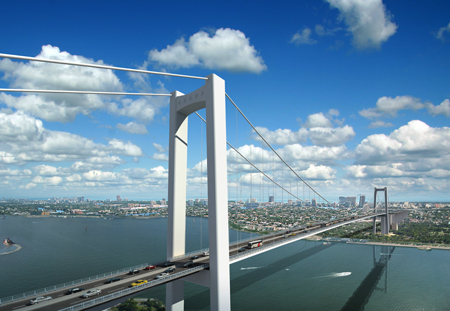
After its completion at the end of next year, the Maputo Bridge will be the longest suspension bridge in Africa, with a main span of 680m and total length of 1,225m, and is also considered the most important project in the south of Mozambique since the country won its independence.
Construction of the bridge started in 2014 with a total project value, including the southern link roads, of US$700 million. Design and execution is being carried out by China Road & Bridge Corporation and is based on Fidic’s Silver book EPC contract. German consultant Gauff Engineering is responsible for quality supervision as well as design verification according to Eurocodes.
The Maputo Bridge will create a new link across the entrance of Maputo’s international seaport and become a key component in the link to South Africa. As Bd&e went to press, all substructures were nearing completion and the towers were clearly visible from the outskirts of the city.
The bridge consists of reinforced concrete approach viaducts on north and south banks of the crossing, which connect to the main span, a suspension bridge of steel box girder deck, with two large subsoil anchor blocks that are filled with sand and concrete. The bridge will carry four lanes of traffic, two in each direction, with a design speed of 80km/h.
The north and south approach bridges will be built by two different design and construction methods based on the local conditions. In the north, the approach bridge will be a balanced cantilever construction of approximately 1km length rising up towards the main bridge with a gentle S-curve in plan. The southern approach bridge will be built using prefabricated post-tensioned T-beams to form its total length of 1,234m. The approach bridges connect on each side to a single-span double-hinged suspension bridge with a centre span of 680m, supported by hangers attached to two 91-strand cables formed of 5mm-diameter strands, which are draped over the main cable saddles of the towers and connected to the anchor blocks on each side of the river. Side spans are 260m and 285m long.
The bridge concept was designed to Chinese standards with the overall design verified against Eurocode specifications. Geological conditions at the site are made up of various strata comprised of imported fill and tidal silt in the upper layers and fine sand and clay in the lower layers. The groundwater level is high due to its proximity to the bay. These adverse soil conditions required several different foundation engineering solutions; diaphragm walls for the anchorage shafts; bored piles up to a diameter of 2.2m drilled with a slurry suspension; subsoil stabilisation using cement-stabilised earth piles; high-pressure grouting below the diaphragm walls; lowering of the groundwater; pile loading tests with embedded hydraulic cylinders; large-scale tests to determine friction of the shaft; driven reinforced-concrete piles and sheet piling.
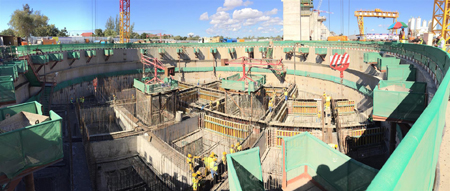
Southern anchorage block construction
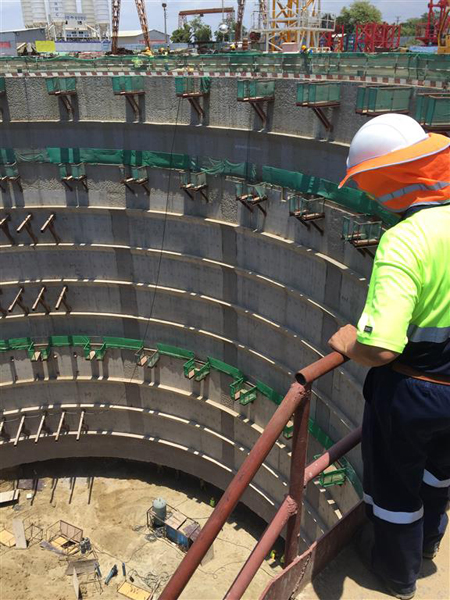
Construction of the shafts of the anchor blocks on the north and south banks started in early 2015. Each gravity anchorage is made up of the foundation, splay-saddle buttress, and anchorage chambers, of which some are empty, amd some are filled with concrete and sand requiring a specific density, all adding to the total weight of the structure. Each shaft has an external diameter of 50m, a wall thickness of 1.2m and a wall panel depth of up to 56m. The deepest anchorage structure was the one on the south side of the crossing; at 37m it is believed to be one of the deepest in the world currently under construction.
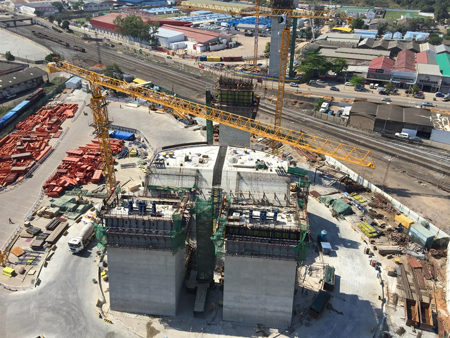
Northern anchorage block
In addition to the excavation profile, the verticality of the diaphragm wall panels was permanently monitored by the use of special Koden measuring devices. Steel pipes were installed into the reinforcement cages to facilitate crosshole sonic logging tests to detect any abnormalities in the self-compacting concrete. Gradually as the excavation works inside of the shafts progressed, the diaphragm wall was reinforced by an internal cast-in-situ concrete lining ring, which was extended up to a thickness of 2.5m towards the bottom. The foundation level at the shaft bottom itself has to carry a tremendous load; on completion, the south anchor block will weigh an impressive 170,000t. Extensive soil and bearing capacity investigations and studies showed that additional soil improvement measures were necessary at the bottom of the 37m-deep excavation. One third of the bottom in-situ surface bearing capacity met the required design bearing capacity; an additional 1.5m depth was excavated from the other third and replaced with C20 concrete and the remaining third was strengthened by installation of 20 unreinforced concrete piles 12m long and with a diameter of 1.5m.
As there was no comparable project in Mozambique for the design of the bridge foundation piles, the design was based on the findings of a geotechnical investigation which started two years ahead of the actual construction work. Pile construction for the towers and foreshore bridge piers began in tandem with the anchorage excavation, and before pile production could begin, their bearing capacity was verified using static test loads. Based on the findings all 331 piles were optimised in both diameter and length. These tests were performed by the University of Nanjing.
The production of the piles followed the international reverse-circulation-drilling method. The quality and integrity of the concrete in all piles was verified over their total length using CSL after 28 days. Compressive strength concrete cubes were manufactured for 7, 28, 90 and even 365-day compressive strength tests and slump testing was done at regular intervals to confirm workability.
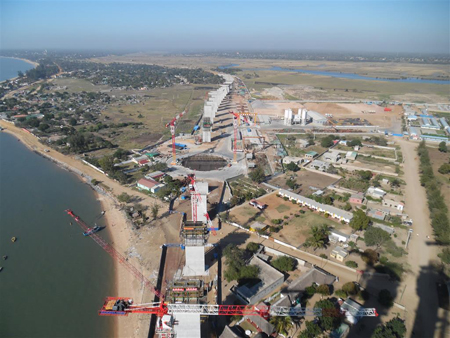
A total of 283 piles was constructed for the approach bridges, each with a diameter of 1.5m and an average depth of 50m, and 48 piles were installed for the towers, 24 at each tower, and each with a diameter of 2.2m and length of 105m at the south tower and 95m at the north.
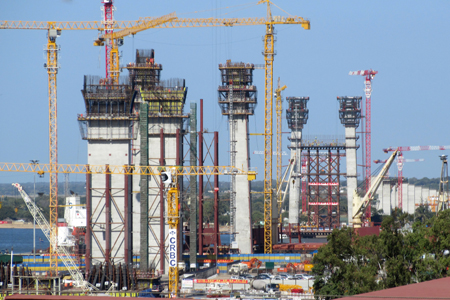
The towers are a frame-shaped structure composed of two vertical legs connected by an upper transverse girder at the top and a lower transverse girder approximately 45m from the north tower base and 42m from the south tower base. To increase lateral stability both tower legs were inclined at 2º towards the bridge centre-line.
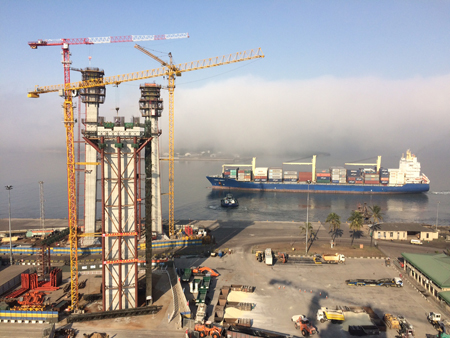
The main structure of the tower is formed of rectangular hollow box sections, with a length of 7m and a width of 5m. The wall thickness of the upper tower is 1m, and this increases to 1.2m towards the bottom, resulting in a total thickness of 1.8m at the base. The final height of the tower on the north, Maputo side, will be 135m and on the south, Katembe side, just a metre higher.
The purpose of the upper and lower beams is to brace the tower legs, and these are made up of rectangular hollow box type sections. The upper beam is 5.5m deep and 6m wide, with a wall thickness of 800mm, and the lower 6m deep and 6m wide, with a wall thickness of 1m.
Prefabricated parallel wire strand will be used for the main cables, which are made up of 91 galvanised high-strength steel wires, 5mm in diameter with a nominal tensile strength of 1,670MPa, resulting in an outside diameter of 509mm and a total strand length of 1,317m. The cables are bound with fixed strapping tape and hot-cast sockets are provided on both ends. Each hot-cast socket is composed of an anchor cup, cover plate, wire divider plate and a zinc copper alloy which is cast inside the anchor cup.
For the hangers, galvanised high strength steel wires will be used. The transverse distance between the main cables and hangers is 21.88m and the standard distance between the hangers along the bridges main span orientation is 12m, with the length of hangers ranging from 73m at the towers to 3m at midspan. Each hanger consists of 61 parallel steel wires, 5mm in diameter, with a strength grade of 1,770MPa. In total there are 55 hangers attached each side to the 57 steel box segments which make up the main span.
These steel box girders are being manufactured in Nantong near Shanghai in China and will be delivered to Maputo by ship by manufacturer ZPMC. Each girder is 3m deep and 25.6m wide, segment lengths are 12m as standard, and there is a central segment of 13m and an end beam segment of 20.39m. The maximum weight of segments is 244t. Segments for the main span are divided into 31 hoisting segments, namely the midspan hoisting segment, standard hoisting segment, closure segment and end hoisting segment.
One of the usual aspects of the concrete on this project was the addition of up to 40% fly ash or pulverised fuel ash. This not only offers immediate cost savings but also long term benefits. The PFA is produced and delivered from South Africa and gives the concrete an extremely high durability, a fact which was confirmed by the University of Cape Town’s Concrete Materials & Structural Integrity Unit which tested samples cored from the bottom slab of the anchorage. Producing sustainable concrete and most importantly a sustainable project is particularly important to CRBC and the client. Achieving a balance of social, environmental and economic factors is part of the contractor’s quality management system which was developed by Gauff Engineering following the ‘Triple Bottom Line’ concept from the United Nations’ Bruntland Report. Through this CRBC aspires to produce a sustainable structure as a whole and to promote sustainability across the board. Reduction of its carbon footprint by reducing CO2 emissions is part of the company’s mix-design philosophy and through the use of PFA as an extender, it has resulted in dramatically lowering the cementatious CO2 emissions of the concrete from an estimated 352.5kg CO2/t to 229.5 kg CO2/t, a reduction of 35%.
Many employees of diverse cultures from Africa, Asia and Europe are working together on this challenging Maputo Bridge contract. Besides expertise, enormous commitment, inter cultural understanding and comprehension of the political, social and economic context is required. The unfamiliar tropical climate adds an additional challenge for European engineers working in Africa for the first time.
For a project of this magnitude, it is the first time that the construction company CRBC has directly employed an international consultant for internal quality control and design verification, which was a requirement of the client. The client was present at the contract negotiations between CRBC and Gauff as well as the preliminary limited tendering. Maputo Sul has also engaged Cowi as consultant for special technical topics.
While Europe has a historically-mature and extensive system of norms and standards, in China there are only a few standards that have been in use for more than 25 years for building structures. Currently the first generation of national standards is being revised.
There is also very limited empirical evidence for comparative studies of standards from China and Europe. While there are research projects supported by the EU for all other fields, like manufactured and trading products, comparative studies in relation to project execution in civil engineering are rare.
For this project, Gauff and CRBC together with the client have developed a comprehensive quality management monitoring system, which covers all aspects of construction in Maputo and also the extensive production of the complex steel components being manufactured in China.
The calculations to Chinese standards and their verification against Eurocodes were completed in June this year, alongside the production of piles and diaphragm walls. Anchorages for the main cables of the bridge are nearing completion and the towers are currently rising towards their final height. In the coming 18 months the construction work will focus on steel fabrication for the suspension bridge, erection of the main cables, lifting of the 57 steel box girder segments, and the respective quality monitoring of the production in China. At the same time the construction of the highly demanding balanced cantilever post tensioned north approach bridge will commence, alongside the southern approach bridge. Handover of the new bridge to the Mozambique nation is currently scheduled to take place in January 2018.
Jörn Seitz is project director for Gauff Engineering and Bai Pengyu is project general manager for CRBC
Client: Republic of Mozambique
Client’s representative: EDMS (Empresa de Desinvolvimento de Maputo Sul)
Client’s consultant: Cowi
Contractor for the EPC contract: China Road & Bridge Corporation
Planning: China Road & Bridge Corporation
Checking engineers: Gauff Engineering, Instat
Quality control: Gauff Engineering